Publications
2026
-
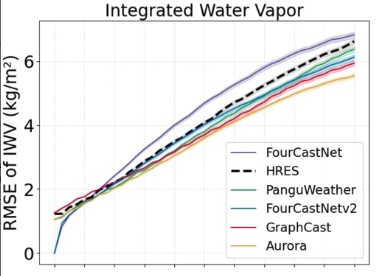 Physics-based versus AI Weather prediction models: A comparative performance assessment of Atmospheric River predictionIsaac W Davis, Aneesh Subramanian, Timothy B Higgins, Agniv Sengupta, and Luca Delle MonacheGeophysical Research Letters, 2026
Machine learning (ML) poses a potential paradigm shift in weather forecasting, but critical questions arise regarding its ability to predict high-impact weather events. This study evaluates five state-of-the-art ML models—Aurora, GraphCast, PanguWeather, FourCastNetV2, FourCastNet—in forecasting U.S. West Coast atmospheric rivers (ARs), compared to the high-performing physics-based European Center for Medium-Range Weather Forecasts’ high-resolution system (HRES) model. Analysis of 152 daily forecast cycles (November 2023–March 2024) reveals significant performance differences between the systems. While ML models often show better variable-specific root mean square error (RMSE), HRES has superior AR detection skill for the first four forecast days. PanguWeather matches HRES skill beyond day four; other ML models lag slightly. Aurora consistently exhibits the lowest AR detection performance, despite strong variable-specific RMSE metrics, highlighting a disconnect between RMSE performance and its ability to predict AR events. These findings underscore the need for phenomenon-specific metrics for ML-based numerical weather prediction model assessment and operational implementation.
@article{davis2026physics, title = {Physics-based versus AI Weather prediction models: A comparative performance assessment of Atmospheric River prediction}, author = {Davis, Isaac W and Subramanian, Aneesh and Higgins, Timothy B and Sengupta, Agniv and Delle Monache, Luca}, journal = {Geophysical Research Letters}, volume = {53}, number = {4}, pages = {e2025GL117609}, year = {2026}, publisher = {Wiley Online Library}, } -
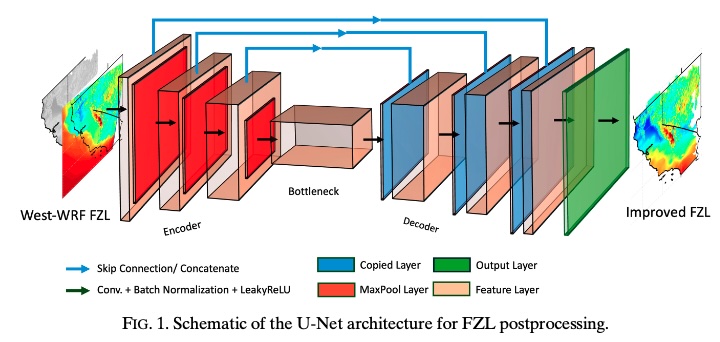 Enhancing Deterministic Freezing-Level Predictions in the Northern Sierra Nevada through Deep Neural NetworksVesta Afzali Gorooh, Agniv Sengupta, Shawn Roj, Rachel Weihs, Brian Kawzenuk, Luca Delle Monache, and F. Martin RalphJournal of Hydrometeorology, 2026
Accurate prediction of the freezing level (FZL) is essential for hydrometeorological forecasting systems, with direct implications for runoff generation and reservoir management. In this study, we develop a deep learning–based postprocessing framework using the U-Net convolutional neural network (CNN) architecture to refine the FZL forecasts from the West Weather Research and Forecasting (West-WRF) Model. The proposed framework leverages reforecast data from West-WRF and FZL estimates from the California Nevada River Forecast Center (CNRFC) to develop U-Net models over the northern Sierra Nevada watersheds, such as the hydrologically critical Yuba–Feather watershed. We introduce two U-Net model variants, U-Net-log and U-Net Gaussian mixture model (U-Net-GMM), that employ specialized loss functions beyond the standard benchmarks to enhance forecast skill. U-Net-log utilizes the log-cosh cosine of error, and U-Net-GMM uses Gaussian mixture model loss functions, to enhance FZL forecasts. Results show that U-Net-based postprocessing reduces centered root-mean-square errors by up to 20% and increases forecast–observation correlation by about 10% compared to raw West-WRF. Evaluation using the continuous ranked probability score (CRPS) for U-Net-GMM further demonstrates consistent improvements across lead times. While performance fluctuates with forecast horizon, storm variability, and diurnal forcing, U-Net-GMM and U-Net-log consistently outperform the baseline. The models capture the spatiotemporal variability of the FZL across different elevations, mitigating biases from the West-WRF Model. This novel deep learning–based postprocessing approach demonstrates a promising pathway for integrating machine learning into hydrometeorological forecasting and decision support within the Forecast-Informed Reservoir Operations (FIRO) framework.
@article{afzali2026enhancing, title = {Enhancing Deterministic Freezing-Level Predictions in the Northern Sierra Nevada through Deep Neural Networks}, author = {Afzali Gorooh, Vesta and Sengupta, Agniv and Roj, Shawn and Weihs, Rachel and Kawzenuk, Brian and Delle Monache, Luca and Ralph, F. Martin}, journal = {Journal of Hydrometeorology}, volume = {27}, number = {2}, pages = {233--255}, year = {2026}, publisher = {American Meteorological Society}, } -
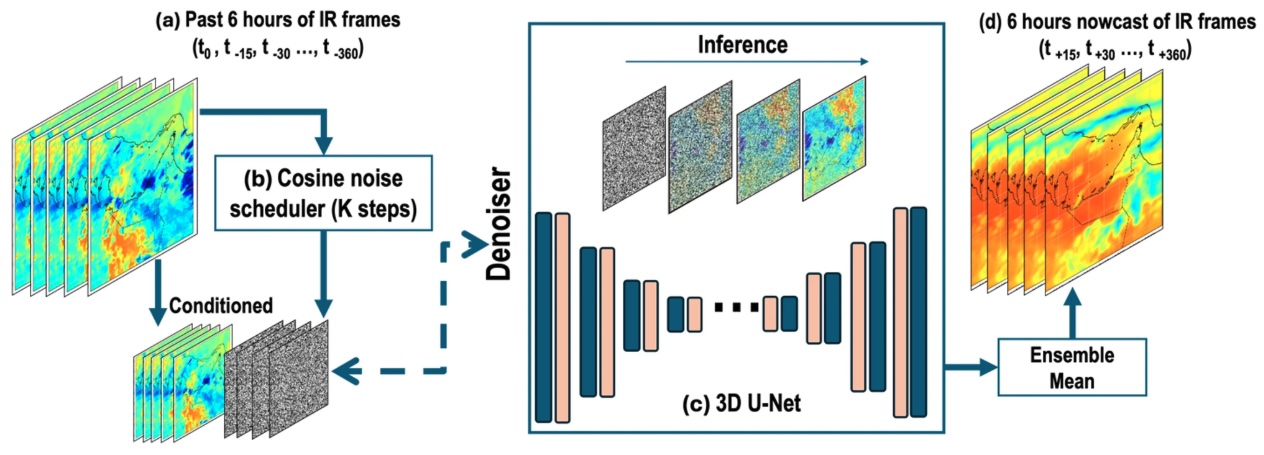 Deterministic nowcasting of geostationary satellite infrared brightness temperature using 3D U-Net diffusion modelVesta Afzali Gorooh, Luca Delle Monache, Duncan Axisa, Agniv Sengupta, Zhenhai Zhang, and Fred Martin RalphScientific Reports, 2026
We present a generative modeling approach for nowcasting infrared (IR) brightness temperatures (Tb) from geostationary satellite observations ( 10.8 μm) that couples a denoising diffusion probabilistic model with a 3D U-Net backbone. Using SEVIRI observations, the model ingests six hours of IR history and produces six-hour nowcasts at 15-min resolution. Deterministic evaluation is performed on an independent July–September 2022 test set and benchmarked against 3D U-Net, ConvLSTM, and Optical Flow extrapolation baselines. The diffusion model enhances prediction accuracy, yielding lower errors and higher correlation than all baselines across most forecast lead times, with a persistent advantage through the 2-hour lead time and reduced but still evident gains at longer leads. We complement the statistical assessments with a perceptual and a probabilistic diagnostic; diffusion achieves the highest SSIM at all leads and the lowest CRPS among all models (CRPS generates MAE for deterministic baselines). RAPSD analysis shows improved retention of high-frequency variance relative to deep learning baselines while avoiding the texture-only limitations of Optical Flow. Spatial maps demonstrate that our diffusion model significantly outperforms the baselines, indicating smaller errors over the study region. Two case studies show coherent structures in Tb forecasts, sharper gradients, and improved localization of evolving cold features. Overall, coupling diffusion with 3D U-Net delivers more structurally faithful satellite nowcasts than traditional extrapolation and deep learning baselines, particularly at short to intermediate leads.
@article{afzali2026deterministic,
  title = {Deterministic nowcasting of geostationary satellite infrared brightness temperature using 3D U-Net diffusion model},
  author = {Afzali Gorooh, Vesta and Delle Monache, Luca and Axisa, Duncan and Sengupta, Agniv and Zhang, Zhenhai and Ralph, Fred Martin},
  journal = {Scientific Reports},
  year = {2026},
  publisher = {Nature Publishing Group UK London},
}
2025
-
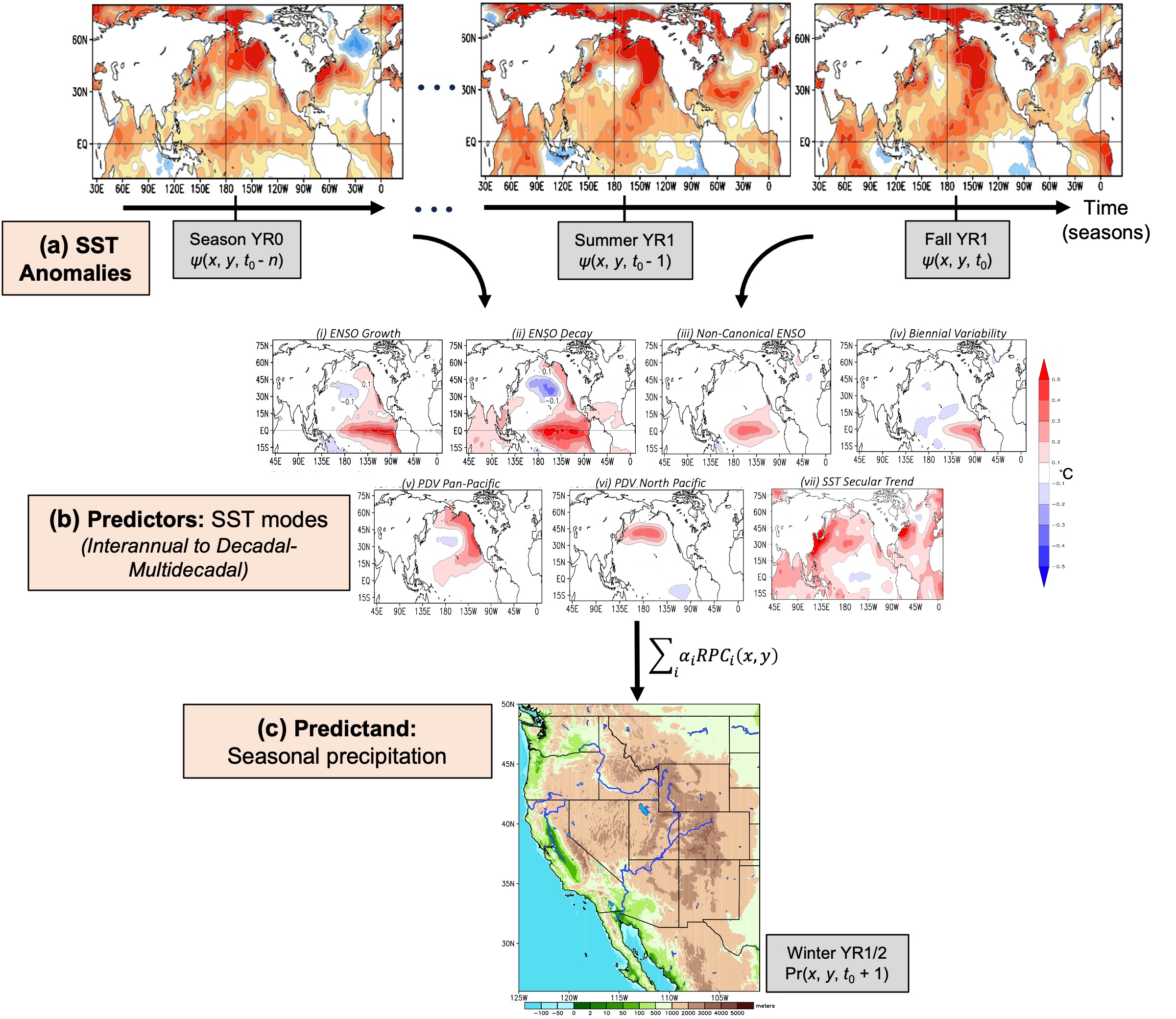 Role of evolving sea surface temperature modes of variability in improving seasonal precipitation forecastsAgniv Sengupta, Duane E Waliser, Michael J DeFlorio, Bin Guan, Luca Delle Monache, and F Martin RalphCommunications Earth & Environment, 2025
The value of improving longer-lead precipitation forecasting in the water-stressed, semi-arid western United States cannot be overstated, especially considering the severity and frequency of droughts that have plagued the region for much of the 21st century. Seasonal prediction skill of current operational forecast systems, however, remain insufficient for decision-making purposes across a variety of applications. To address this capability gap, we develop a seasonal forecasting system that leverages the long-term memory of leading global and basin-scale modes of sea surface temperature variability. This approach focuses on characterizing and capitalizing on the spatiotemporal evolution of predictor modes over multiple antecedent seasons, instead of the customary use of predictive information from just the current season. Another distinctive methodological feature is the incorporation of sources of predictability spanning multiple timescales, from interannual to decadal-multidecadal. An evaluation of the forecast system’s performance from cross-validation analyses demonstrates skill over core winter precipitation regions—California, Pacific Northwest, and the Upper Colorado River basin. The developed model exhibits superior skill compared to dynamical and statistical benchmarks in predicting winter precipitation. Experimental seasonal precipitation forecasts from the model have the potential to provide critical situational awareness guidance to stakeholders in the water resources, agriculture, and disaster preparedness communities.
@article{sengupta2025role, title = {Role of evolving sea surface temperature modes of variability in improving seasonal precipitation forecasts}, author = {Sengupta, Agniv and Waliser, Duane E and DeFlorio, Michael J and Guan, Bin and Delle Monache, Luca and Ralph, F Martin}, journal = {Communications Earth \& Environment}, volume = {6}, number = {1}, pages = {256}, year = {2025}, publisher = {Nature Publishing Group UK London}, } -
 A regional high resolution AI weather model for the prediction of atmospheric rivers and extreme precipitationJorge Baño-Medina, Agniv Sengupta, Daniel Steinhoff, Patrick Mulrooney, Thomas Nipen, Mario Santa-Cruz, Yanbo Nie, and Luca Delle Monachenpj Climate and Atmospheric Science, 2025
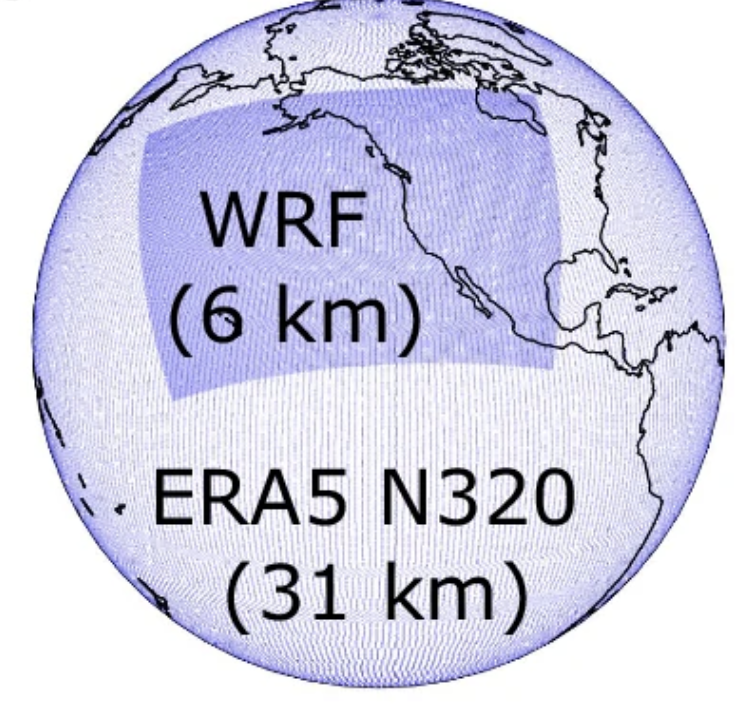
Accurate precipitation forecasting often relies on high-resolution numerical weather prediction (NWP) models, which are essential for capturing fine-scale and nonlinear atmospheric dynamics. However, the computational demands of these models can be substantial. Leveraging recent advancements in artificial intelligence (AI), we present a stretched-grid AI-driven weather model with 6-km horizontal grid increments over the Western United States and 31 km in other regions globally. The model employs an autoregressive framework to generate forecasts in minutes and is evaluated against global and regional NWP systems, as well as a lower-resolution AI model. Our results show that the regional AI model reduces 24-h accumulated precipitation errors, performs competitively with the regional NWP model, and effectively captures extreme precipitation events, particularly those linked to atmospheric rivers, which global coarser models often underestimate. This work underscores the potential of regional, high-resolution AI models for precipitation forecasting at km-scales, and discusses some of the challenges for future development.
@article{bano2025regional, title = {A regional high resolution AI weather model for the prediction of atmospheric rivers and extreme precipitation}, author = {Ba{\~n}o-Medina, Jorge and Sengupta, Agniv and Steinhoff, Daniel and Mulrooney, Patrick and Nipen, Thomas and Santa-Cruz, Mario and Nie, Yanbo and Delle Monache, Luca}, journal = {npj Climate and Atmospheric Science}, volume = {8}, number = {1}, pages = {385}, year = {2025}, publisher = {Nature Publishing Group UK London}, } -
 Are AI weather models learning atmospheric physics? A sensitivity analysis of cyclone XynthiaJorge Baño-Medina, Agniv Sengupta, James D Doyle, Carolyn A Reynolds, Duncan Watson-Parris, and Luca Delle Monachenpj Climate and Atmospheric Science, 2025
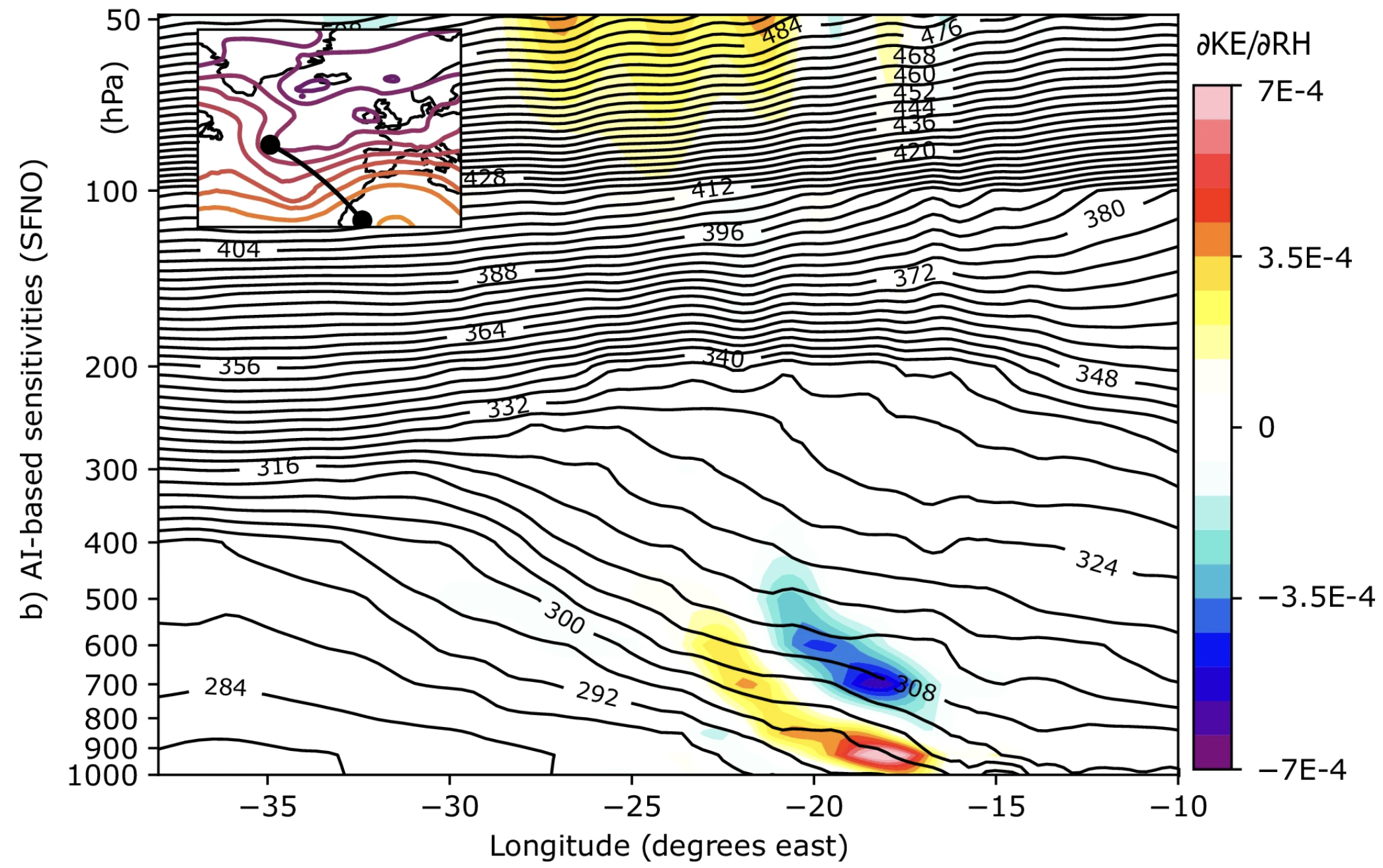
Artificial Intelligence (AI) weather models are explored for initial condition sensitivity studies to analyze the physicality of the relationships learned. Gradients (or sensitivities) of the target metric of interest are computed with respect to the variable fields at initial time by means of the backpropagation algorithm, which does not assume linear perturbation growth. Here, sensitivities from an AI model at 36-h lead time were compared to those produced by an adjoint of a dynamical model for an extreme weather event, cyclone Xynthia, presenting very similar structures and with the evolved perturbations leading to similar impacts. This demonstrates the ability of the AI weather model to learn physically meaningful spatio-temporal links between atmospheric processes. These findings should enable researchers to conduct initial condition studies in minutes, potentially at lead times into the non-linear regime (typically >5 days), with important applications in observing network design and the study of atmospheric dynamics.
@article{bano2025ai, title = {Are AI weather models learning atmospheric physics? A sensitivity analysis of cyclone Xynthia}, author = {Ba{\~n}o-Medina, Jorge and Sengupta, Agniv and Doyle, James D and Reynolds, Carolyn A and Watson-Parris, Duncan and Monache, Luca Delle}, journal = {npj Climate and Atmospheric Science}, volume = {8}, number = {1}, pages = {92}, year = {2025}, publisher = {Nature Publishing Group UK London}, } - Toward calibrated ensembles of neural weather model forecastsJorge Baño-Medina, Agniv Sengupta, Duncan Watson-Parris, Weiming Hu, and Luca Delle MonacheJournal of Advances in Modeling Earth Systems, 2025
Neural Weather Models (NWM) are novel data-driven weather forecasting tools based on neural networks, that have recently achieved comparable deterministic forecast skill to current operational approaches using significantly less real-time computational resources. They require short inference times, which can potentially improve the characterization of forecast uncertainty by designing very large ensembles, which is of paramount importance for for example, extreme events, and critical for various socio-economic sectors. Here we propose a novel ensemble design for NWMs spanning two main sources of uncertainty: model uncertainty and initial condition uncertainty. For the model uncertainty, we propose an effective strategy for creating a diverse ensemble of NWMs that captures uncertainty in key model parameters. For the initial condition uncertainty, we explore the “breeding of growing modes” for the first time on NWMs, a technique traditionally used for operational numerical weather predictions to estimate the initial condition uncertainty. The combination of these two types of uncertainty produces an ensemble of NWM-based forecasts that is shown to improve upon benchmark probabilistic NWM and is competitive with the 50-member ensemble of the European Centre for Medium-Range Weather Forecasts based on the Integrated Forecasting System (IFS), in terms of both error and calibration. Results are particularly promising over land for three key variables: total column water vapor, surface wind and surface air temperature. The proposed strategy is scalable, enabling the generation of very large ensembles (>100) with potential applications for extreme events.
@article{bano2025toward, title = {Toward calibrated ensembles of neural weather model forecasts}, author = {Ba{\~n}o-Medina, Jorge and Sengupta, Agniv and Watson-Parris, Duncan and Hu, Weiming and Delle Monache, Luca}, journal = {Journal of Advances in Modeling Earth Systems}, volume = {17}, number = {4}, pages = {e2024MS004734}, year = {2025}, publisher = {Wiley Online Library}, } -
 Harnessing AI data-driven global weather models for climate attribution: An analysis of the 2017 Oroville Dam extreme atmospheric riverJorge Baño-Medina, Agniv Sengupta, Allison Michaelis, Luca Delle Monache, Julie Kalansky, and Duncan Watson-ParrisArtificial Intelligence for the Earth Systems, 2025
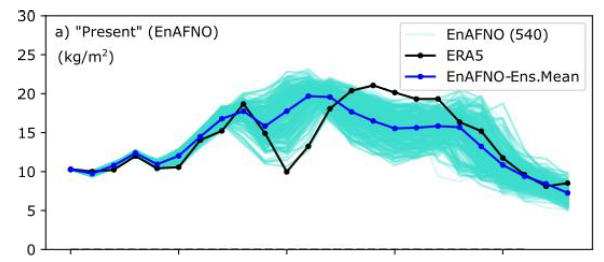
Artificial intelligence (AI) data-driven models [GraphCast, Pangu-Weather, FourCastNet, and spherical Fourier neural operator (SFNO)] are explored for storyline-based climate attribution due to their short inference times, which can accelerate the number of events studied and provide real-time attributions when public attention is heightened. The analysis is framed on the extreme atmospheric river episode of February 2017 that contributed to the Oroville Dam spillway incident in Northern California. “Past” and “future” simulations are generated by perturbing the initial conditions with the preindustrial and the late twenty-first century temperature climate change signals, respectively. The simulations are compared to the results from a dynamical model which represents plausible “pseudorealities” under both climate environments. Overall, the AI models show promising results, projecting a 5%–6% increase in the integrated water vapor over the Oroville Dam in the present day compared to the preindustrial, in agreement with the dynamical model. Different geopotential–moisture–temperature dependencies are unveiled for each of the AI models tested, providing valuable information for understanding the physicality of the attribution response. However, the AI models tend to simulate weaker attribution values than the “pseudoreality” imagined by the dynamical model, suggesting some reduced extrapolation skill, especially for the late twenty-first century regime. Large ensembles generated with an AI model (>500 members) produced statistically significant present-day to preindustrial attribution results, unlike the >20-member ensemble from the dynamical model. This analysis highlights the potential of AI models to conduct the attribution analysis, while emphasizing future lines of work on explainable artificial intelligence to gain confidence in these tools, which can enable reliable attribution studies in real time.
@article{bano2025harnessing, title = {Harnessing AI data-driven global weather models for climate attribution: An analysis of the 2017 Oroville Dam extreme atmospheric river}, author = {Ba{\~n}o-Medina, Jorge and Sengupta, Agniv and Michaelis, Allison and Delle Monache, Luca and Kalansky, Julie and Watson-Parris, Duncan}, journal = {Artificial Intelligence for the Earth Systems}, volume = {4}, number = {3}, pages = {240090}, year = {2025}, publisher = {American Meteorological Society}, } -
 Improving Weeks 1–2 Temperature Forecasts in the Sierra Nevada Region Using Analog Ensemble Postprocessing with Implications for Better Prediction of Snowmelt, Water Storage, and StreamflowZhiqi Yang, Weiming Hu, Agniv Sengupta, Luca Delle Monache, Michael J DeFlorio, Mohammadvaghef Ghazvinian, Mu Xiao, Ming Pan, Jacob Kollen, Andrew Reising, and othersJournal of Hydrometeorology, 2025
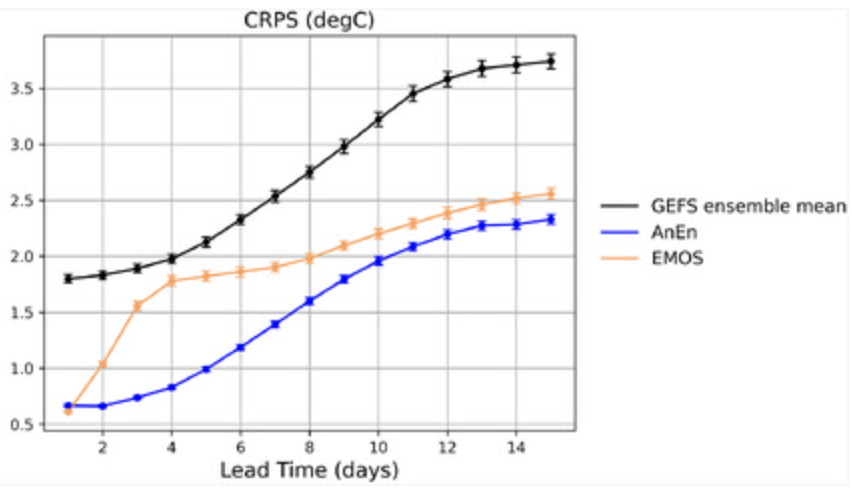
California relies on the Sierra Nevada spring snowmelt for 60% of its water, serving 23 million people. Forecasting this snowmelt is vital for water supply planning and is a key task of the California Department of Water Resources’ Bulletin 120. Accurate predictions rely on subseasonal 2-m temperature (T2m) forecasts, especially at high elevations where snowpack and runoff contributions are greatest. Current systems like the California Nevada River Forecast Center’s (CNRFC) Hydrologic Ensemble Forecast Service (HEFS) have identified T2m forecasts as a key uncertainty source. However, research on fine-resolution subseasonal temperature forecasting in complex terrain is limited. This study uses the Parameter-Elevation Regressions on Independent Slopes Model (PRISM) dataset as ground truth and National Oceanic and Atmospheric Administration (NOAA) Global Ensemble Forecast System (GEFS) reforecasts to apply analog ensemble (AnEn) postprocessing, producing high-resolution (4 km) daily T2m forecasts for the Sierra Nevada. We find that during the spring snowmelt season (April–July), AnEn reduces T2m forecast root-mean-square error by 1°C (60% for 1-day lead, 20% for 15-day lead), increases correlation by ∼11%, extends skill by an additional week beyond dynamical benchmarks, and illustrates added value beyond a basic bias correction method (the ensemble model output statistics). Improvements are more pronounced at higher elevations (e.g., 3000–3500 m), with root-mean-square error reduced by 4°C, correlation rising from 0.1 to 0.9, and skill extended by 2 weeks. By enhancing T2m accuracy for Bulletin 120 and CNRFC-HEFS systems, AnEn can boost the precision of snowmelt and streamflow predictions, supporting improved water resource management in a changing climate.
@article{yang2025improving, title = {Improving Weeks 1--2 Temperature Forecasts in the Sierra Nevada Region Using Analog Ensemble Postprocessing with Implications for Better Prediction of Snowmelt, Water Storage, and Streamflow}, author = {Yang, Zhiqi and Hu, Weiming and Sengupta, Agniv and Delle Monache, Luca and DeFlorio, Michael J and Ghazvinian, Mohammadvaghef and Xiao, Mu and Pan, Ming and Kollen, Jacob and Reising, Andrew and others}, journal = {Journal of Hydrometeorology}, volume = {26}, number = {10}, pages = {1511--1523}, year = {2025}, publisher = {American Meteorological Society}, } -
 Improving streamflow simulation through machine learning-powered data integration and its potential for forecasting in the Western USYuan Yang, Ming Pan, Dapeng Feng, Mu Xiao, Taylor Dixon, Robert Hartman, Chaopeng Shen, Yalan Song, Agniv Sengupta, Luca Delle Monache, and F. Martin RalphHydrology and Earth System Sciences, 2025
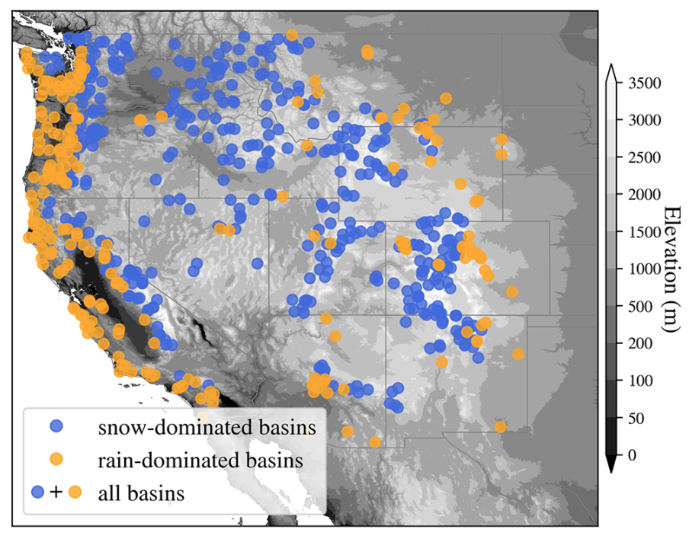
Accurate streamflow forecasts are crucial but remain challenging for the arid Western United States (U.S.). Recently, machine learning methods such as long short-term memory (LSTM) have exhibited high accuracy in streamflow simulation and strong abilities to integrate observations to enhance performance. This study evaluated an LSTM-based data integration approach that incorporates streamflow (Q) and snow water equivalent (SWE) observations to improve streamflow estimations across different lag times (1–10 d, 1–6 months) and timescales (daily and monthly) over hundreds of basins in the Western U.S. Integrating Q at the daily scale provided the greatest improvements, increasing the median Kling-Gupta Efficiency (KGE) of 646 basins from 0.80 to 0.96 when integrating 1 d lagged Q, and remaining at 0.89 even with a 10 d lag. Integrating Q at the monthly scale also enhanced streamflow estimations, though to a lesser extent than at the daily scale, with the median KGE rising from 0.80 to 0.86 when integrating 1-month lagged streamflow. The next most notable improvement resulted from integrating SWE at the monthly scale, where the median KGE improved to 0.86 when integrating 1-month lagged SWE. Furthermore, SWE integration showed greater benefits at the monthly scale in snow-dominated basins during snowmelt season, which was beneficial for spring-summer flow estimations. However, integrating SWE at the daily scale did not show improvements. These results highlight the potential of this LSTM-based data integration approach for both short-term and long-term streamflow forecasting due to its performance, automation and efficiency.
@article{yang2025improvinh, title = {Improving streamflow simulation through machine learning-powered data integration and its potential for forecasting in the Western US}, author = {Yang, Yuan and Pan, Ming and Feng, Dapeng and Xiao, Mu and Dixon, Taylor and Hartman, Robert and Shen, Chaopeng and Song, Yalan and Sengupta, Agniv and Delle Monache, Luca and Ralph, F. Martin}, journal = {Hydrology and Earth System Sciences}, volume = {29}, number = {20}, pages = {5453--5476}, year = {2025}, publisher = {Copernicus Publications G{\"o}ttingen, Germany}, } -
 Global daily discharge estimation based on grid long short-term memory (LSTM) model and river routingYuan Yang, Dapeng Feng, Hylke E Beck, Weiming Hu, Ather Abbas, Agniv Sengupta, Luca Delle Monache, Robert Hartman, Peirong Lin, Chaopeng Shen, and Ming PanWater Resources Research, 2025
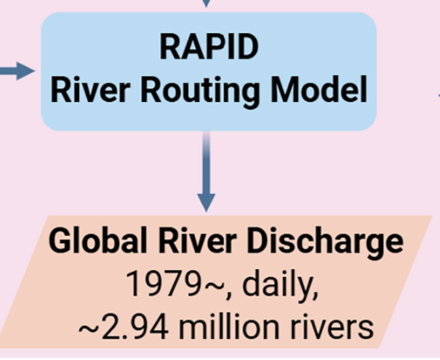
To expand the spatial coverage of the conventional Basin Long Short-Term Memory (LSTM) model for river discharge estimation beyond pre-selected individual locations, we developed a discharge modeling scheme, Grid LSTM-RAPID, to estimate discharge for every river reach worldwide. Grid LSTM-RAPID applies LSTM runoff estimation to the grids (0.25°), small rectangular hydrological response units (HRUs) rather than basins (irregularly shaped HRUs of any size), and then routes the grid runoff over all reaches on a global river network using the RAPID routing model. It largely maintains the strong performance of Basin LSTM over gauged basins and achieves a median Kling-Gupta Efficiency (KGE) of 0.653 for small basins out-of-sample both temporally and spatially (0.688 for out-of-sample temporally), and a median KGE of 0.592 for other basins with larger areas and less data quality. Compared to Basin LSTM, Grid LSTM-RAPID loses about 0.03 in median KGE for basins out-of-sample in both time and space in exchange for global all-reach coverage without heavy cost. Despite this tradeoff, it significantly outperforms a well-calibrated process-based benchmark model. Using the new scheme, we create an improved global reach-level daily discharge data set from 1980 to near present named GRADES-hydroDL, which is openly shared at https://www.reachhydro.org/home/records/grades-hydrodl.
@article{yang2025global,
  title = {Global daily discharge estimation based on grid long short-term memory (LSTM) model and river routing},
  author = {Yang, Yuan and Feng, Dapeng and Beck, Hylke E and Hu, Weiming and Abbas, Ather and Sengupta, Agniv and Delle Monache, Luca and Hartman, Robert and Lin, Peirong and Shen, Chaopeng and Pan, Ming},
  journal = {Water Resources Research},
  volume = {61},
  number = {6},
  pages = {e2024WR039764},
  year = {2025},
  publisher = {Wiley Online Library},
}
2024
-
 From California’s extreme drought to major flooding: evaluating and synthesizing experimental seasonal and subseasonal forecasts of landfalling atmospheric rivers and extreme precipitation during winter 2022/23Michael J DeFlorio, Agniv Sengupta, Christopher M Castellano, Jiabao Wang, Zhenhai Zhang, Alexander Gershunov, Kristen Guirguis, Rosa Luna Niño, Rachel ES Clemesha, Ming Pan, and othersBulletin of the American Meteorological Society, 2024
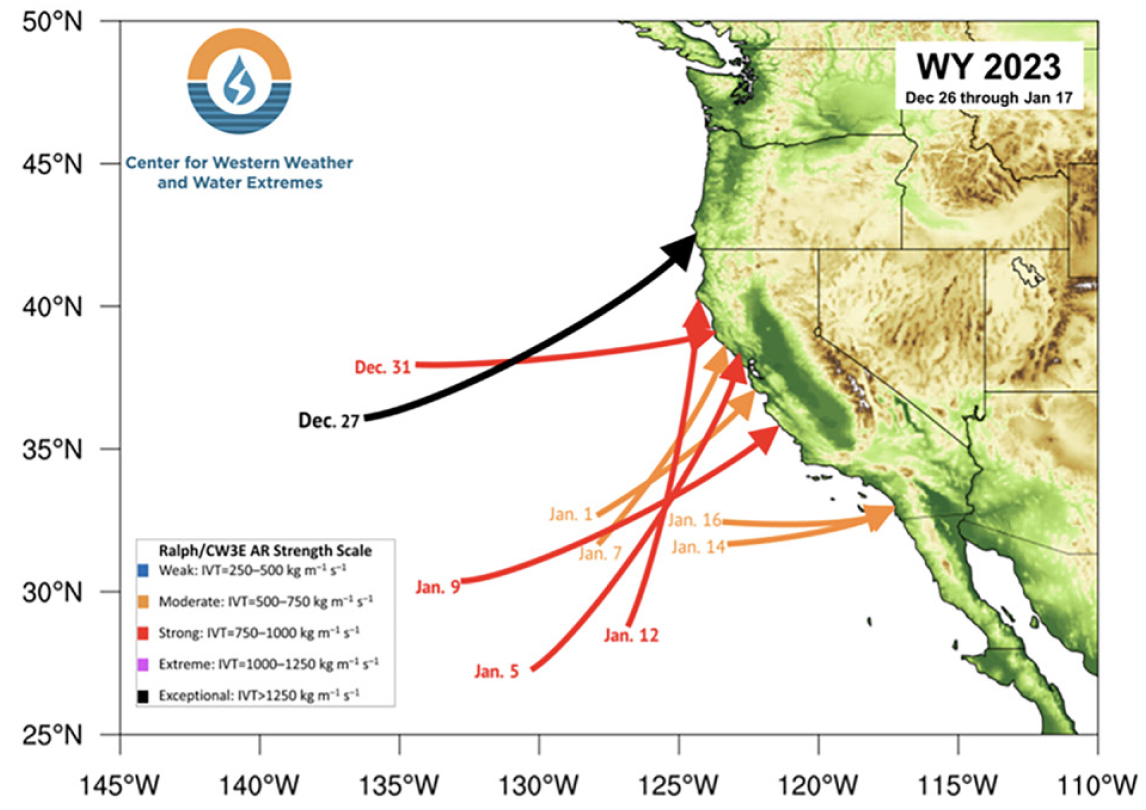
California experienced a historic run of nine consecutive landfalling atmospheric rivers (ARs) in three weeks’ time during winter 2022/23. Following three years of drought from 2020 to 2022, intense landfalling ARs across California in December 2022–January 2023 were responsible for bringing reservoirs back to historical averages and producing damaging floods and debris flows. In recent years, the Center for Western Weather and Water Extremes and collaborating institutions have developed and routinely provided to end users peer-reviewed experimental seasonal (1–6 month lead time) and subseasonal (2–6 week lead time) prediction tools for western U.S. ARs, circulation regimes, and precipitation. Here, we evaluate the performance of experimental seasonal precipitation forecasts for winter 2022/23, along with experimental subseasonal AR activity and circulation forecasts during the December 2022 regime shift from dry conditions to persistent troughing and record AR-driven wetness over the western United States. Experimental seasonal precipitation forecasts were too dry across Southern California (likely due to their overreliance on La Niña), and the observed above-normal precipitation across Northern and Central California was underpredicted. However, experimental subseasonal forecasts skillfully captured the regime shift from dry to wet conditions in late December 2022 at 2–3 week lead time. During this time, an active MJO shift from phases 4 and 5 to 6 and 7 occurred, which historically tilts the odds toward increased AR activity over California. New experimental seasonal and subseasonal synthesis forecast products, designed to aggregate information across institutions and methods, are introduced in the context of this historic winter to provide situational awareness guidance to western U.S. water managers.
@article{deflorio2024california, title = {From California’s extreme drought to major flooding: evaluating and synthesizing experimental seasonal and subseasonal forecasts of landfalling atmospheric rivers and extreme precipitation during winter 2022/23}, author = {DeFlorio, Michael J and Sengupta, Agniv and Castellano, Christopher M and Wang, Jiabao and Zhang, Zhenhai and Gershunov, Alexander and Guirguis, Kristen and Luna Ni{\~n}o, Rosa and Clemesha, Rachel ES and Pan, Ming and others}, journal = {Bulletin of the American Meteorological Society}, volume = {105}, number = {1}, pages = {E84--E104}, year = {2024}, publisher = {American Meteorological Society}, } -
 Deep learning of a 200-member ensemble with a limited historical training to improve the prediction of extreme precipitation eventsMohammadvaghef Ghazvinian, Luca Delle Monache, Vesta Afzali Gorooh, Daniel Steinhoff, Agniv Sengupta, Weiming Hu, Matthew Simpson, Rachel Weihs, Caroline Papadopoulos, Patrick Mulrooney, and othersMonthly Weather Review, 2024
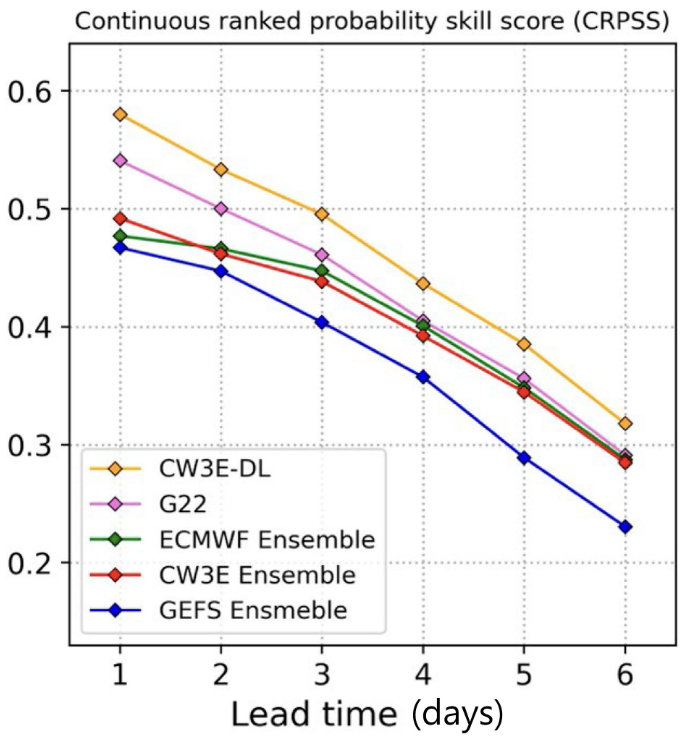
This study introduces a deep learning (DL) scheme to generate reliable and skillful probabilistic quantitative precipitation forecasts (PQPFs) in a postprocessing framework. Enhanced machine learning model architecture and training mechanisms are proposed to improve the reliability and skill of PQPFs while permitting computationally efficient model fitting using a short training dataset. The methodology is applied to postprocessing of 24-h accumulated PQPFs from an ensemble forecast system recently introduced by the Center for Western Weather and Water Extremes (CW3E) and for lead times from 1 to 6 days. The ensemble system was designed based on a high-resolution version of the Weather Research and Forecasting (WRF) Model, named West-WRF, to produce a 200-member ensemble in near–real time (NRT) over the western United States during the boreal cool seasons to support Forecast-Informdayed Reservoir Operations (FIRO) and studies of prediction of heavy-to-extreme events. Postprocessed PQPFs are compared with those from the raw West-WRF ensemble, the operational Global Ensemble Forecast System version 12 (GEFSv12), and the ensemble from the European Centre for Medium-Range Weather Forecasts (ECMWF). As an additional baseline, we provide PQPF verification metrics from a recently developed neural network postprocessing scheme. The results demonstrate that the skill of postprocessed forecasts significantly outperforms PQPFs and deterministic forecasts from raw ensembles and the recently developed algorithm. The resulting PQPFs broadly improve upon the reliability and skill of baselines in predicting heavy-to-extreme precipitation (e.g., >75 mm) across all lead times while maintaining the spatial structure of the high-resolution raw ensemble.
@article{ghazvinian2024deep, title = {Deep learning of a 200-member ensemble with a limited historical training to improve the prediction of extreme precipitation events}, author = {Ghazvinian, Mohammadvaghef and Delle Monache, Luca and Afzali Gorooh, Vesta and Steinhoff, Daniel and Sengupta, Agniv and Hu, Weiming and Simpson, Matthew and Weihs, Rachel and Papadopoulos, Caroline and Mulrooney, Patrick and others}, journal = {Monthly Weather Review}, volume = {152}, number = {7}, pages = {1587--1605}, year = {2024}, publisher = {American Meteorological Society}, } -
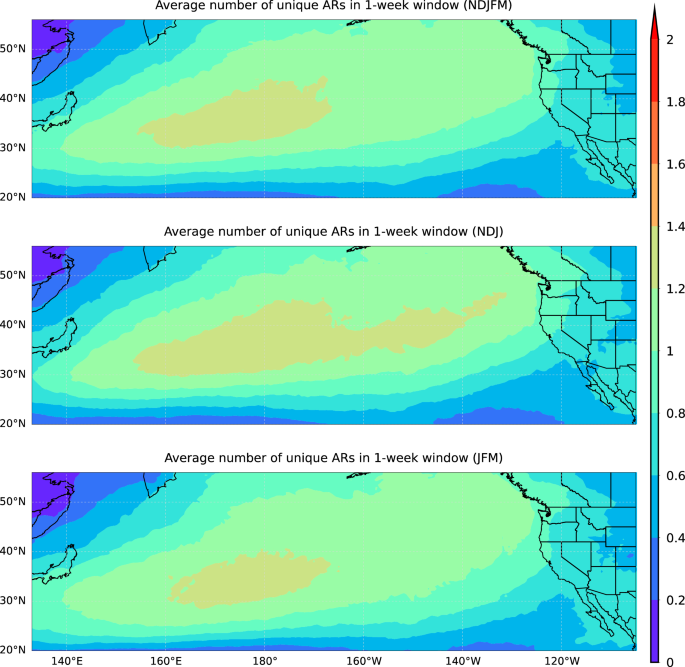 Seasonality and climate modes influence the temporal clustering of unique atmospheric rivers in the Western USZhiqi Yang, Michael J DeFlorio, Agniv Sengupta, Jiabao Wang, Christopher M Castellano, Alexander Gershunov, Kristen Guirguis, Emily Slinskey, Bin Guan, Luca Delle Monache, and othersCommunications Earth & Environment, 2024
Atmospheric rivers (ARs) are narrow corridors of intense water vapor transport, shaping precipitation, floods, and economies. Temporal clustering of ARs tripled losses compared to isolated events, yet the reasons behind this clustering remain unclear. AR orientation further modulates hydrological impacts through terrain interaction. Here we identify unique ARs over the North Pacific and Western U.S. and utilize Cox regression and composite analysis to examine how six major climate modes influence temporal clustering of unique ARs and orientation during extended boreal winter (November to March). Results show that climate modes condition temporal clustering of unique ARs. The Pacific-North American weather pattern strongly modulates the clustering over the Western U.S. from early to late winter. The quasi-biennial oscillation and Pacific decadal oscillation affect late winter clustering, while the Arctic oscillation dominates early winter. Climate modes also strongly influence AR orientation, with ENSO particularly affecting the orientation of temporally clustered ARs.
@article{yang2024seasonality,
  title = {Seasonality and climate modes influence the temporal clustering of unique atmospheric rivers in the Western US},
  author = {Yang, Zhiqi and DeFlorio, Michael J and Sengupta, Agniv and Wang, Jiabao and Castellano, Christopher M and Gershunov, Alexander and Guirguis, Kristen and Slinskey, Emily and Guan, Bin and Delle Monache, Luca and others},
  journal = {Communications Earth \& Environment},
  volume = {5},
  number = {1},
  pages = {734},
  year = {2024},
  publisher = {Nature Publishing Group UK London},
}